
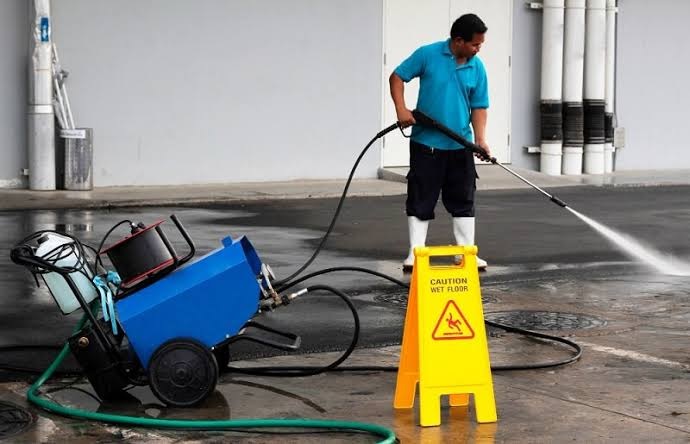
Routine cleaning keeps a facility presentable. It does not reach the places where contamination actually accumulates inside ductwork, above suspended ceilings, behind fixed machinery, in floor drains and on structural steelwork ten metres up. Those deposits build quietly over months and years, and they carry consequences that a mop cannot address. Industrial deep cleaning services exist to reset those accumulations before they become a hazard or a shutdown.
What Distinguishes Deep Cleaning From Routine Work
The difference is depth of access rather than intensity of effort. Routine cleaning covers accessible surfaces on a frequent cycle. Deep cleaning dismantles, moves or reaches into what routine work goes around: extraction systems, ceiling voids, plant rooms, structural members, drainage channels, the undersides and interiors of equipment. It requires specialist access equipment, stronger chemistry, trained operators and usually a shutdown window. It also happens far less often, which is why the accumulation between visits can be substantial.
Where High-Traffic Facilities Suffer Most
Volume of movement accelerates every failure mode. Floors in high-traffic areas hold ground-in oil and process residue that ordinary scrubbing cannot lift, producing a persistently slippery surface. Airborne dust and grease circulate and settle on high-level surfaces and inside ventilation systems. Frequently touched surfaces accumulate contamination faster than a standard cleaning schedule removes it. Drains and gullies block with solids and become both an odour source and a flood risk during heavy rain.
The Safety Case
The strongest argument for this work is risk rather than appearance. Slips on contaminated flooring remain a leading cause of workplace injury. Combustible dust on high-level surfaces creates genuine explosion potential when disturbed and ignited. Grease accumulation in extraction ductwork is a well-documented fire pathway that has destroyed premises. Dust on motors, panels and cooling systems causes overheating and unplanned downtime. Each of these is a measurable, insurable risk that deep cleaning directly reduces.
Access, Height and Confined Spaces
Much of the target contamination sits above head height or inside enclosures, which changes the nature of the work considerably. High-level cleaning requires appropriate access equipment and certificated operators, with exclusion zones established below. Confined space entry tanks, ducts, pits, silos demands a permit-to-work system, atmospheric testing, forced ventilation, continuous monitoring, a standby person and a rehearsed rescue plan. A credible provider produces these procedures and the associated training records on request rather than describing them in general terms. The guidance on what a commercial cleaning company should hold in the way of accreditation is a useful benchmark when assessing that.
Planning Around Production
Deep cleaning usually requires equipment to be stopped, which makes scheduling the hardest part of the project. The practical approach ties the work to planned maintenance shutdowns, seasonal slow periods or weekend windows agreed well in advance. Isolation and lockout of machinery must be completed and verified before anyone cleans near it. Sequencing matters too, so that finished areas are not immediately re-contaminated by work happening above or adjacent to them.
Chemistry and Compatibility
Industrial cleaning agents are considerably more aggressive than general-purpose products, and selection has to account for both the contaminant and everything it will contact. Strong alkalis attack aluminium and some coatings. Certain solvents degrade seals, gaskets and cable insulation. Some combinations react dangerously. Safety data sheets belong on site, operators need handling training and appropriate protection, and rinse water requires managed disposal rather than being pushed toward the nearest drain.
Setting the Right Interval
Frequency should follow measured accumulation rather than convention. Inspect, record how quickly deposits build in the areas that matter, and set the cycle from that evidence. A facility producing fine combustible dust may need high-level cleaning several times a year; a light assembly operation may need it annually. Extraction systems in food production have their own requirements driven by grease deposition rate. Reviewing the interval after the first full year against what inspections actually find is what turns a guess into a programme.
Documentation That Survives an Audit
The record produced is a substantial part of the value. Risk assessments and method statements per activity, permits to work, operator certification, before-and-after photographic evidence, a schedule of areas cleaned with dates, and waste transfer documentation for anything hazardous. This package demonstrates due diligence to regulators and insurers, and it is far easier to assemble as the work proceeds than to reconstruct after an incident has prompted the question.
Choosing a Provider
Sector experience matters, since food production, chemical processing and heavy engineering carry different requirements and different regulatory expectations. Ask what equipment is owned versus hired, how operators are trained, and whether method statements from comparable projects can be shared. Providers who also deliver professional office cleaning services can often cover a whole facility including administrative areas under one arrangement, which reduces coordination overhead and usually improves commercial terms.
The Return on the Investment
Deep cleaning is a periodic cost with an unglamorous benefit: incidents that do not happen, equipment that does not fail, downtime that does not occur, and audits that pass without findings. None of these are visible, which is exactly why the work gets deferred. The facilities that manage it well treat it as scheduled maintenance rather than as discretionary cleaning, and their incident records reflect that.

