
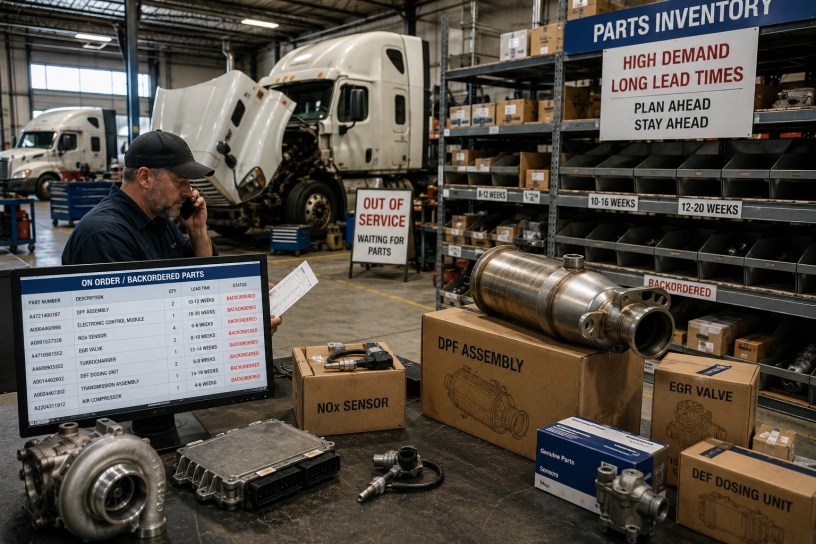
Fleet operators who managed through the supply chain disruptions of the early 2020s hoped the experience was temporary. It largely wasn’t. The structural factors that produced extended lead times, parts shortages, and unpredictable availability for heavy-duty commercial truck components have evolved rather than resolved — and in 2025, new pressures from tariff policy changes, ongoing semiconductor scarcity, and manufacturing workforce constraints have extended the challenge into a second cycle.
For fleet managers responsible for keeping commercial vehicles on the road, the parts availability environment has fundamentally changed the planning horizon for maintenance management. The strategies that worked when DPF units were available in two days and ECMs could be sourced in a week are inadequate when those same components now carry 8 to 20-week lead times. Adapting to this reality requires a different approach to inventory management, supplier relationships, and maintenance scheduling — one that treats parts availability as a strategic constraint rather than a logistical detail.
What Is Driving the Current Parts Shortage
The heavy-duty parts supply chain is under pressure from multiple simultaneous factors, each compounding the others:
- Semiconductor scarcity: Electronic control modules, telematics systems, and advanced driver assistance components all depend on semiconductors that remain in constrained supply. ECM lead times for Class 8 trucks have extended to 12 to 20 weeks or longer in some applications — components that previously carried 2 to 4-week availability. Engine manufacturers and dealers are managing allocation queues rather than open stock.
- Tariff impacts: The 2025 tariff environment affecting imports from China, Mexico, and Canada has disrupted aftermarket parts pricing and availability significantly. Many aftermarket components previously sourced from offshore manufacturers have become substantially more expensive or temporarily unavailable as importers work through inventory and sourcing adjustments.
- Aftertreatment component delays: Diesel particulate filter substrates, SCR catalysts, and DEF dosing components face 6 to 12-week lead times due to raw material scarcity. For fleets running high-mileage trucks approaching DPF service intervals, the inability to source replacement filters on short notice is generating extended downtime.
- Hydraulic and drivetrain components: Hydraulic pumps and cylinders that previously had 10 to 14-day availability now average 10 to 14-week lead times. Transmission assemblies have extended from 3 weeks to 4 months in some cases — creating extended downtime for trucks requiring major drivetrain repair.
- Workforce constraints in distribution: Parts distribution centers face staffing shortages that slow order processing and shipping. The physical availability of a component in a warehouse does not guarantee rapid delivery when pick-and-ship operations are understaffed.
The Financial Impact on Fleet Operations
Parts shortages affect fleet financial performance through two channels: direct downtime cost and reactive purchasing cost. Both are significant.
A commercial truck sitting in a repair bay waiting for a part generates between $448 and $760 per day in lost revenue according to Element Fleet Management research — and for high-utilization Class 8 vehicles, the daily figure can exceed $1,500 when full operating costs are accounted for. A 4-week wait for an ECM that could have been stocked represents $12,000 to $25,000 in avoidable downtime cost per truck.
The reactive purchasing cost is equally damaging. Fleet managers who discover they need a critical component without advance notice frequently pay premium prices through emergency sourcing channels — overnight freight on a component that would have cost 40 percent less ordered three weeks earlier, or sourcing from a broker rather than a distributor at inflated margin. These costs rarely appear explicitly in maintenance budgets but accumulate significantly over a full fleet cycle.
Building a Proactive Parts Inventory Strategy
The fundamental shift required in the current environment is from just-in-time parts purchasing to strategic inventory management. For most commercial fleets, this means maintaining on-hand stock of the high-risk, long-lead-time components most likely to cause extended downtime — even at the cost of tied-up capital.
Identifying which parts to stock requires analyzing your fleet’s historical failure patterns by component and model year. Components with high failure frequency, long sourcing lead times, and high downtime cost per day of unavailability are the stocking priorities. For most diesel truck fleets operating post-2010 emissions equipment, that list reliably includes:
- DPF units or cleaning service capacity arrangements for upcoming service intervals
- NOx sensors and DEF dosing injectors for the SCR system
- EGR valves and cooler assemblies for the specific engine families in your fleet
- Turbocharger assemblies or remanufactured cores for high-mileage trucks approaching expected turbo service life
- Engine control modules (ECMs) on allocation from your OEM dealer for upcoming replacements
The capital cost of maintaining this inventory is real but manageable when weighed against the downtime cost of waiting 8 to 20 weeks for a component that sidelines a revenue-generating asset.
Supplier Relationships as a Strategic Asset
Parts availability in a constrained market is not just a function of what is in stock — it is a function of who you know and how you are positioned in their allocation queue. Fleet managers who treat supplier relationships as purely transactional find themselves at the back of the line when supply is short. Those who have invested in genuine supplier partnerships have access to allocation that isn’t visible on public ordering systems.
This means regular communication with your dealer parts managers and independent distributor representatives — not just when you need something urgently. It means sharing your anticipated parts requirements 60 to 90 days in advance when possible, giving suppliers the lead time to position inventory on your behalf. It means understanding your distributor’s own supply chain situation so you can anticipate constraints before they affect your operation.
Multi-sourcing is equally important. Fleets that have qualified both OEM and quality aftermarket suppliers for critical components have options when one channel is constrained. Having an established relationship with a reputable remanufacturer for turbochargers, injectors, and aftertreatment components provides an alternative supply chain when new OEM parts face extended delays.
Preventive Maintenance as the First Line of Defense
The most effective parts shortage strategy is reducing unplanned demand for critical components through disciplined preventive maintenance. A DPF that is monitored, cleaned on schedule, and replaced before failure never becomes an emergency sourcing problem. An EGR cooler that is inspected for early signs of coolant seepage and replaced during planned downtime doesn’t generate a surprise parts-hunting exercise when it fails catastrophically on the road.
Preventive maintenance shifts parts consumption from unpredictable, urgent demand to planned, scheduled purchasing — which is the only demand profile that benefits from advance sourcing and volume pricing. Fleets with mature PM programs buy the same parts as reactive fleets but buy them in advance, at standard prices, with adequate lead time to manage current supply chain constraints.
Selecting the right digital tools to manage PM scheduling, parts inventory, and service records is foundational to this approach. A comprehensive evaluation of preventive maintenance software for heavy duty fleets covers the leading platforms across fleet size and operational profile — helping operators identify solutions that automate scheduling, track parts consumption, and generate reorder alerts before stock runs out.
Staying Informed on Supply Chain Conditions
The heavy-duty parts supply chain is not static. Lead times for specific components shift based on manufacturer production schedules, raw material availability, and distribution capacity — and staying current on those conditions is increasingly part of the fleet manager’s job in ways it wasn’t five years ago.
Practical intelligence sources include your OEM dealer’s parts department (who typically have visibility 30 to 60 days into their supply pipeline), trade publications covering the commercial vehicle industry, and peer networks of fleet managers in non-competing operations who share sourcing intelligence. Fleet associations — including ATA, NPTC, and regional motor carrier associations — provide member communications on supply chain developments that can give advance warning of component category constraints before they affect your purchasing.
For fleet managers who want a current, detailed view of the component categories under the most pressure and the sourcing strategies that are working for operators managing through the shortage, the heavy duty parts supply chain guide at Heavy Duty Journal covers the current constraint landscape and practical mitigation approaches in detail.
The Operational Mindset That Makes the Difference
Fleet operators who navigate parts shortages successfully share a consistent mindset: they think about parts the same way they think about cash flow — as a resource that requires active management, advance planning, and strategic positioning, not a commodity that can be sourced on demand whenever the need arises.
The supply chain environment has changed what it means to manage a fleet well. Adding parts availability planning to the fleet manager’s strategic responsibilities — with the same rigor applied to maintenance scheduling, driver management, and regulatory compliance — is not an optional upgrade. In the current environment, it is a core competency that separates fleets that maintain uptime from those that don’t.
About the Author:- Michael Nielsen is the editor and publisher of Heavy Duty Journal, a free digital trade publication serving diesel technicians, fleet managers, and owner-operators in the commercial trucking industry. He brings 15+ years of hands-on experience in diesel repair and fleet operations to HDJ’s editorial coverage.

